With Ms. Maria Archer, EMES Principal
At Eastern Mennonite Elementary School (EMES), peacebuilding isn’t just a class—it’s the heartbeat of the community. Principal Maria Archer, who has led this school for over 20 years, describes the culture as one where “every student is known and seen, safe to be who they are, and safe to make mistakes.” It’s a place where children learn to live in community and to grow as confident, compassionate individuals. “Kids have so much power within themselves and so much knowledge and ability to do the right thing,” Archer says. “If we give them a safe environment and some guidance, they will figure it out.”
EMPOWERING STUDENTS TO RESOLVE CONFLICT
The belief that students can “figure it out” shapes every interaction at EMES. When playground conflicts arise, Archer invites students into her office to talk it through. “I hold my tongue,” she admits. “I have an idea of what I think should happen, but the kids come up with their own solutions—and they’re often different, sometimes better, than what I imagined. That’s what peacebuilding is.” Sometimes the students initiate conflict resolution on their own using STORY steps, an acronym used to guide them through a conflict: Set the guidelines, Tell your side of the story, Offer solutions, Reach an Agreement, and Yay! Celebrate. Not only do they practice at school, they bring it home too. One parent recalled, “I overheard my two EMES students arguing outside and then one said, ‘I know, let’s do STORY steps!’” These skills build and they transform.
FORMING THE CULTURE
A fundamental principle of EMES’ philosophy, guided by Peacebuilding teacher Becky Long, is the Peace Pledge. Students and teachers sign the pledge, which emphasizes listening to each other, considering others’ perspectives, playing creatively, and caring for the environment. Archer recalls when, years ago, a group of students noticed trash on the playground. “They came to me, very passionate about it. I asked, ‘What do you think we should do?’ They created a cleanup club, gathered the bags, made announcements, and really owned the project. I didn’t initiate that— they did.”
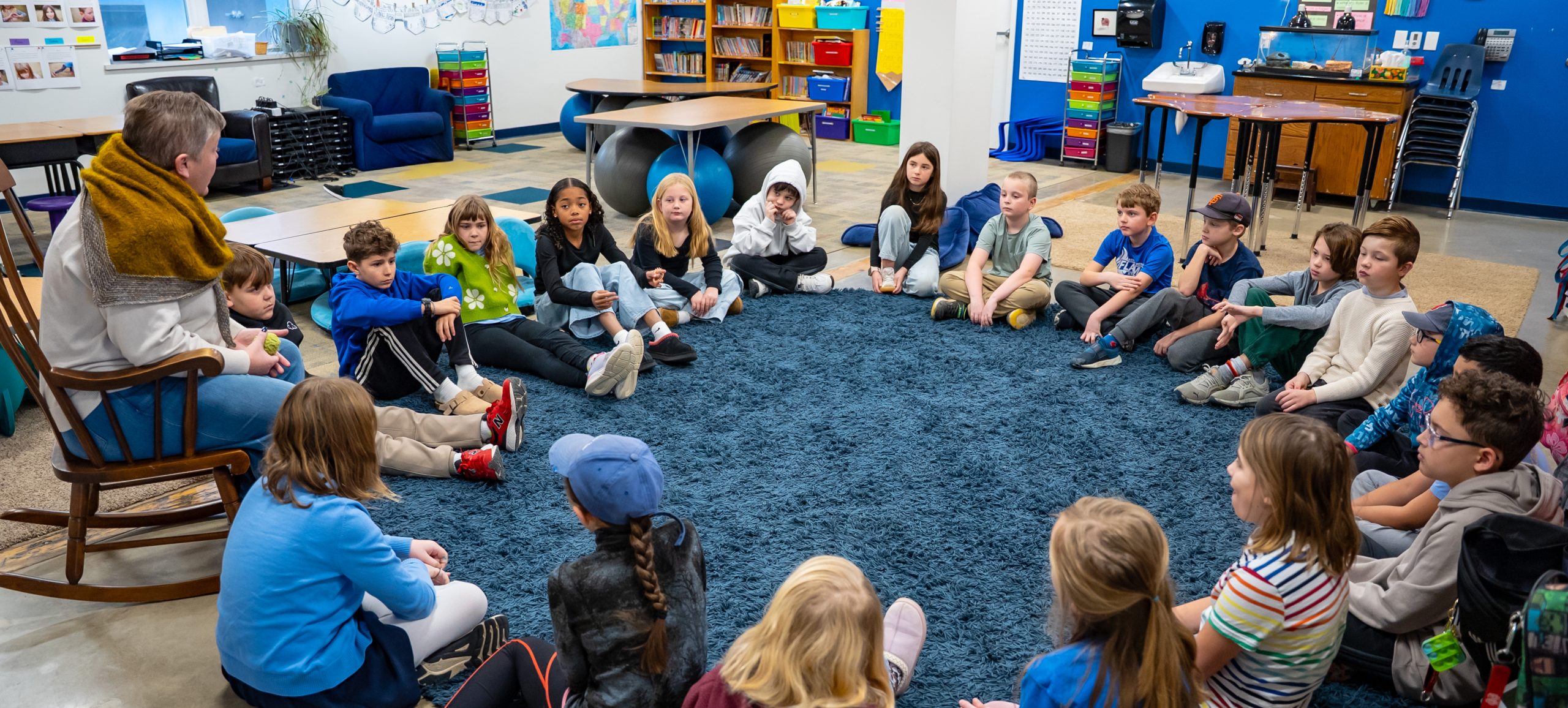
One way we put the pledge into action in the classroom is the Circle process—a way for students to share feelings, solve problems, and build understanding. Recently, third graders used a Circle to address frustrations over fort-building in the woods. Stu- dents expressed how hard they worked every day to make cool structures, only to have their forts disrupted by other classes. Together, their teacher Ms. Byler helped them reflect on how other grades might feel the same way. “This is the good, hard stuff of life,” Archer says. “Students learned that no one owns the forts, other kids aren’t the enemy, and we can all learn to live in community together.” For Archer, peacebuilding is also about encouraging a culture that allows mistakes, especially in academics. “You want noisy classrooms,” she insists. “If kids are afraid to be wrong, they won’t contribute. When a child answers a math problem incorrectly, we affirm their thinking and then explore why it didn’t work. That builds confi- dence and curiosity.”
The goal is clear: to teach children not just curriculum, but to also build empathy, grow together, and give them tools to shape their world. As Archer reflects, “We are teachers of kids, first and foremost. Developing who they are and will be is not just our skillset—it’s our calling. We love our work, and we love our children.”